Saturday, July 5, 2008

Jews and Ostriches


Jews and ostriches... what comes to mind?

Well, there's discussion in the Torah of ostriches - in Vayikra they are listed as being non-kosher, and they are mentioned in the book of Iyov and other places as being cruel.

Then there is the old custom in some parts of the world to hang ostrich eggs in shuls. This is due to the ancient belief that ostriches incubate their eggs by staring at them, emitting energy from their eyes. Accordingly, ostrich eggs were hung in shuls to remind people of the power of kavanah.

But here in South Africa, there's a different connection between ostriches and Jews. At the turn of the twentieth century, ostrich feathers were all the rage in women's fashions. A town called Oudtshoorn in South Africa emerged as the ostrich farming capital of the world, and it was a business that was dominated by Jews. The Jews of Oudtshoorn were very religious, and the town became such a center of Torah that it became known as "the Jerusalem of Africa."

Ostrich feathers have long since fallen out of fashion, and the Jewish community of Oudtshoorn now numbers only fourteen families, all religious. The book pictured above is a commemoration of the remarkable days of the ostrich Jerusalem in Africa.

(Thanks to the Jewish Museum of Cape Town for permission to take this picture.)

Thursday, July 3, 2008

A Bird in the Hand


A bird in the hand is worth two in the bush. So rather than spend all my time here searching for wild animals - where there is never a guarantee of success - I am also looking for unique opportunities to meet captive animals.

One such opportunity came today at Spier Eagle Encounters. Unfortunately the weather was appalling, so there were no shows. But I was able to put on a falconer's glove and hold two magnificent birds of prey: a Wahlberg's eagle and a huge Verreaux's eagle. The latter was less accustomed to being held, and had to be kept hooded so as to ensure that it would remain calm. I was amazed at how heavy it was - about twelve pounds. I could feel the strength of its talons even through the very heavy glove; without the glove, it would have pierced my flesh to the bone without even trying. Large eagles are so powerful that in some parts of the world, people train them to hunt wolves. An eagle can plunge out of the sky with such force that it can smash into the back of a wolf's skull and kill it. While I have handled numerous birds of prey in the past, this was my first encounter with eagles, and it was awe-inspiring.

On my way out of Spier, I saw a slave bell, which is a relic of the old South Africa. This large bell, mounted about twenty feet up in the air, would be rung to sound the alarm in the event that slaves escaped! How times have changed.

The Only Store Of Its Kind!


On the way back from our shark expedition, I noticed a store with the odd name of "Baboon Matters." The name alone was intriguing, but even more fascinating was the billboard outside, which advertised is as "The World's Only Baboon Store!" I had to go in.


No, they didn't sell baboons. But they did sell every possible baboon-related artefact, and for a good reason.


Baboon Matters is not just a store; it is an organization run by people who are trying to solve the southern peninsula's Big Baboon Problem. The cape of South Africa is no longer the rough jungle that it used to be, where hippo and crocodile roamed. It is now quite heavily populated, although leopards still roam. But a serious problem is created by baboons. About two hundred and fifty of these large, powerful primates live in this region, and they don't believe in fearing man. They will readily break into houses to wreak havoc and steal food. You don't want to mess with a baboon; they are immensely powerful, with teeth scarcely inferior to those of a leopard. Conflicts between people and baboons can cause serious injuries on both sides. (Many people in this region have put bars on the windows and keep their doors locked, although for those who came from Johannesberg this can be annoying - it's exactly what they came to get away from!)


This is where Baboon Matters comes in. They encourage the villages to take appropriate precautions to keep the baboons away, but even more importantly, they have trained a large number of Baboon Monitors - locals who monitor the activities of the baboons. Aside from being a valuable means of employment in poverty-stricken South Africa, this is a huge help to solving the Big Baboon Problem. The Baboon Monitors are expert trackers who follow the baboons and encourage them to stay away from villages.


Of course, this huge project struggles for funding, and that's where the store comes in. You can buy baboon toys, baboon T-shirts, etc., etc. There are also some interesting artefacts on display, such as the preserved baboon fetus in jar. All in all, Baboon Matters is a wonderful and unique effort to help both people and animals.


Sporting with Leviathan


Two hours before sunrise this morning, I headed out to the Marina for a very special boat trip: an expedition to watch great white sharks predating on seals. But the weather forecast was grim: temperatures were dropping, the wind was building up, and rain was forecast along with sixteen-foot waves. We met on the dock with Rob, the captain (whose previous clients for these expeditions include Peter Benchley, author of Jaws) and the marine biologists who were going along, to discuss our options in light of the steadily worsening weather. It was clear that cage-diving with the sharks would be out of the question; as Rob put it, it would be like being inside a clothes-washing machine. But could we go out at all? We decided to risk it, and we could head back if conditions became too rough.

I was slightly alarmed by the fact that the boat was only about sixteen feet long. Some of the great white sharks in these parts grow bigger than that. I had watched a video of a small shark jumping out onto a large boat; if a big shark tried that with our boat, it would neatly sink us. Rob assured me that we would be very unlucky for that to happen, which didn't seem to answer my concern.

We loaded our gear onto the boat and headed out into the darkness. It was freezing; I was shivering despite wearing three jackets, gloves and a scarf. The waves were large, tossing the boat around as we surged out to sea. Would we get to observe our quarry?

At this point, I should probably explain what all this was about. The great white shark, of Jaws fame, is the largest carnivorous fish in the sea. They are rarely seen, but near Seal Island, in the Cape of Good Hope, they are not only reliably spotted, but are even seen engaging in a certain extroardinary behavior. They swim below seals, then launch themselves upwards to attack, with a force that sometimes takes them fully clear of the water. Rob's partner Chris was the first to observe this behavior some years ago, and they created a stunning National Geographic video special, entitled Air Sharks.

After about forty minutes, as the sun came up, we reached Seal Island. It was small, no more than a few hundred yards long, but the number of fur seals living on it was extraordinary; as I later discovered, there are eighty-four thousand of them living there. Many were sitting on the rocky island, surrounded by penguins and other seabirds, while others bobbed around in the surrounding waves. But in order to eat, they had to go fishing, and this meant venturing beyond the safety of the island to deeper water. The sharks knew this, which is why they came to these parts. Unlike other fish, great white sharks are warm-blooded, and they have to consume several seals a day in order to fuel their huge bodies.

We circled the island, watching the water intently. It was not long before someone yelled, "Predation, three o' clock!" We looked and saw a flurry of commotion in the water, but it was hard to make out details. A seal's flipper, a shark's tail, and lots of splashing. Then silence, as the birds flew down to feast upon the remnants. Shortly afterwards we witnessed another predation. We did not get a clear look this time either, but we did see the shocking sight of a fountain of foamy blood, some three feet high, spurting out of the sea as the shark hit its prey.

On our next sighting, a little later, we saw a little more. This time the seal, desperately seeking to escape its pursuer, leapt out of the water as it swam, porpoise-style. It was followed by the huge triangular dorsal fin of the shark, slicing through the water. This was over quickly, with little commotion; perhaps the shark had downed it in a single gulp.

A long time passed with no further sightings; then we saw the ultimate sight. A huge shark exploded out of the water. It was right there, straight out of Jaws: dark back, white belly, vast gaping mouth, and soulless black eyes. It landed back in the ocean with a tremendous splash, as another seal lost its life.

This was to be the last sighting of the morning, despite our trying to attract the sharks by pulling a dummy seal behind the boat. The weather was getting worse, and the sharks, thought to be sensitive to pressure changes, were probably going deep. Rob decided that it would be best to head back. I heartily agreed; in fact I was beginning to feel considerably nauseous at this point. As a precaution, I gulped down a motion-sickness pill, and promptly threw up my breakfast over the side of the boat.

Unfortunately, aside from the nausea, this had the effect of making my body-temperature plummet. In the already-freezing conditions, this made me shiver violently, feeling appallingly sick. Yet there was nothing to be done; I just had to tough it out all the way back. Finally we reached the hilly coast. "Not a moment too soon," I croaked as we approached the dock, and then as we pulled in, I leaned over the side and lost last night's dinner.

But it was worth it for the experience. Yesterday I had Esa einai el he-harim brought to life; today it was a verse from Barchi Nafshi, which we recited today for Rosh Chodesh. As part of celebrating the grandeur of creation, it comments upon the ocean: "This is the ocean, great and broad... where boats travel, and this Leviathan that You have formed, to sport in it."
And what a sport it is!

Wednesday, July 2, 2008

"I lift my eyes up to the mountains..."


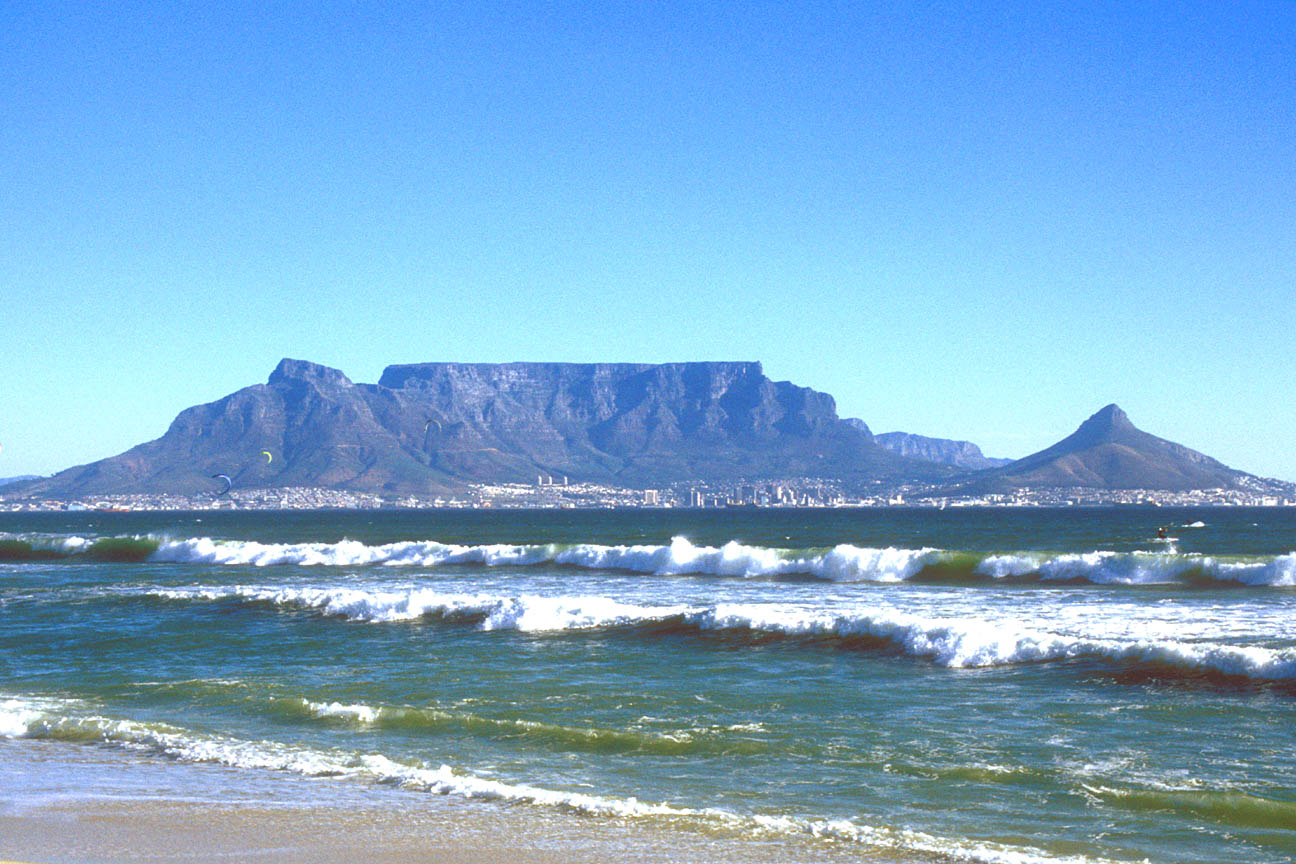
On the Aron HaKodesh at the shul here in Cape Town, it says, "Esa einay el ha-harim... I lift my eyes up to the mountains, where shall my help come from?" This famous verse, followed by "My help comes from God, Creator of Heavens on Earth" can be found in many shuls. However what makes it unique here is that over the Aron is a large window, through which one sees the gigantic mass of Table Mountain looming over the shul. Now that's what I call bringing a passuk to life!

First Impressions

Just as I suspected, there are lots of differences between Mombasa, Kenya and Cape Town, South Africa:

Mombasa, Kenya: Appallingly bad and bumpy roads.
Cape Town, South Africa: Highways with three lanes in each direction.

Mombasa, Kenya: Greeted by black Africans in native dress singing tribal songs.
Cape Town, South Africa: Greeted by white Africans saying shalom aleichem.

Mombasa, Kenya: The only form of contact with outside world is international phone calls, which almost never work.
Cape Town, South Africa: Aside from the phone, there is high-speed internet in the airport and at the home where I am staying until I join my group.

Mombasa, Kenya: Upon arrival, served exotic fruit juices.
Cape Town, South Africa: Upon arrival, served tea with milk at 4pm prompt.

Mombasa, Kenya: I have to keep the door to my room closed, because monkeys tend to come in and steal things.
Cape Town, South Africa: I don't have to keep the door to my room closed, because the family dog is exceptionally well-trained.

(From this point on, things can only get more exotic!)

Tuesday, July 1, 2008

Return to Africa!


I'm writing this from Ben-Gurion airport, as I await to board my flight to Africa. It's been ten years since I was last (and first) there, and this trip will be very different. Last time I went to Kenya; this time, I am traveling to South Africa, Zambia and Botswana. Last time, I went on safari as a participant; this time, I am ZooRabbi-in-residence for a large group, American Friends of Shaarei Tzedek. It's really extraordinary; as a kid, growing up in England, I never in my wildest dreams imagined that I would actually ever visit Africa, and now I am going for the second time!
You can read my photo-journal from my Kenya safari here. I would like to be able to post a photo/video journal while I am on this trip, but from what I hear, getting online is not going to be easy, and certainly not a high-speed connection. But we'll see what we can do!
I'll be starting off in Cape Town, where I had made arrangements to go cage-diving with great white sharks on Thursday. Unfortunately, the forecast is for a raging gale with sixteen-foot waves (it's midwinter there), so this plan will probably have to be shelved. But if the weather picks up on Sunday, maybe I'll be able to do it then. (Insert joke here about how some people want to see me be thrown to the sharks.)
In my bag is something quite remarkable: a sefer Torah less than six inches tall! We'll be needing it when we're out in the bushveldt. I also had an interesting halachic question - should I be saying Morid HaTal, or Mashiv Ha-Ruach? After all, it is the winter there. My posek ruled that I should continue saying Morid HaTal, and said that even for native South Africans it's not clear that they should say Mashiv HaRuach.
So, I don't know when I'll next be posting, but it should be interesting!